Introduction
The process of globalization that began in the 90’s changed the competitive Brazilian market for the international scenario. As a consequence, industries of this country were pushed to accomplish the expectations and needs of customers to survive in the environment of intense competition. In the business, this reality was to search for greater participation in national and international markets. But to achieve this aim it is necessary to develop effective strategies for the sustainable accomplishments. Given this, the question arises: what are the best strategies to be planned and executed when the reality encompasses Small and Micro Enterprises (SMEs), with scarce resources, inadequate technology, lacks of skilled labor or ways to research for new products?
From this question presents itself nowadays the concept of networks of cooperation, a number of SMEs that seek to increase demand for its products. A specific strategy of cooperation networks is to organize in the form of clusters. The clusters are designed to grow with the united actions of micro and small businesses, educational institutions, financial providers, and public efforts. But these clusters need, after their training phases, to maintain a mature organization and evolution, that is, its consolidation. In this sense, this research aims to present levels of consolidation strategies of Brazilian clothing manufacturing clusters with more than 5 years of organization.
1. Strategy Management
Companies have the need to develop strategic alliances, which tend to join forces in action, in order to achieve a production process and different abilities to innovate, aiming to further enhance its competitive viability. But this vision requires strategies and the direction of actions planning. The strategy of research can be divided into macro and micro. The strategies include macro in a heightened sense of organization. The concept of micro-strategy is defined in four basic strategies focused on the organization and consolidation of business that are competitive strategies, cooperation, knowledge and production, but these are subdivided into other strategies and actions to implement them according to the needs of the company and the market.
The difficulty is to transform business strategies of an isolated company, in strategic network of companies with different businesses, heterogeneous cultures, in a greater awareness for the future. The clusters are aimed at obtaining a space in the market as a consequence of greater profit through joint strategies of firms (Carpinetti, Galdamez and Gerolamo, 2008).
However, when dealing with strategies for clusters, only one organization or network of companies, it is appropriate to conceptualize basic competitive strategies, cooperative, knowledge sharing, and production. Souza and Arica (2006) conceptualize competitive strategies in the marketplace selective, as the ability of companies to adopt certain technical standards, procedures and operational routines. Characteristics of each sector, with its respective environment, are influenced by one side and local tradition and culture of others. Still another way the specific demands of the market in terms of quality, flexibility and diversity of the price of each product. All this is called the path of competitive strategy.
The corporate strategy is available in natural and unavoidable situations, characteristics of business diversification, which, if ignored, leads to failure of any strategy of an organization. These situations happen because: competition occurs at the level of business units, diversifications inevitably entail costs and restrictions, investors are able to diversify their investments at any time (Porter, 1998). Cooperation for SMEs becomes a strategy to achieve an active participation of a given market, without the pattern of mass production. But a reality of "clustering of survival" nomenclature completed by Altenburg and Meyer-Stamer (1999), which means sustainable development or sustainability of their business and consequently the development of the region where it is inserted.
The creation of knowledge as a strategy in an organization is the ability of a company to create the information, spread it in the organization as a whole and incorporate it into products, services and systems (Nonaka and Takeuchi, 2002). The power of knowledge and the relationship between people, developed from networks of relationships, including business networks, can make cities and regions rich in relation to knowledge and financial resources.
The relationship between the networks (both formal and informal) of the city are collections of people from organizations of entrepreneurs, students, workers, students, investors and government officials, officers and ministers, identified by their connections with and among organizations, groups and networks (Webb, 2008). Thus, the strategy of knowledge, both in management and in the transfer process, aims to transmit learning for the entire network. Strengths for its spread are partnerships with research centers and educational institutions, especially for companies which product differentiation is essential for maintaining the market and making clothing.
The last strategy is the production that focuses on a set degree of importance to the performance criteria and formulates policies consistent with this priority for the various areas. To achieve this competitive edge companies need an increasing differentiation of products. Thus it is essential to a strategy of production for the manufacturing flexibility of their products (Joiner et al., 2009). The production strategies, competition, knowledge and cooperation aim to effective performance in organizations. Through these strategies it is possible to acquire funding, knowledge, among other actions together.
For a company to be a reference in the competitive market it must have strength in competitive strategies, cooperative, knowledge and full production. Because they are closely interlinked, it is possible to think about business strategies without thinking about how to compete in the market and execute the competitive strategy. However, this requires a strategy of production, for better performance. It is necessary to transfer the knowledge, which is indispensable cooperation of individuals from all sectors of the organization and finally the strategy of cooperation.
2. Strategic Routes to the Future of Paranaense Industry Project: innovation for competitiveness
Strategy Route for the Future of Paranaense Industry Project (PSRIP) used a methodology of roadmapping to map the sectors connected to the region with a tendency of growth between the periods 2005 to 2015. The objective of this project was to map out strategies and visions for the future of Brazilian industry and the ways to attain the international market through innovation (SENAI, 2007). The roadmapping aims to bring the company or agency to think about the future structure and growth paths and actions to achieve the planned objectives.
The term roadmapping is an Englishman word in which to Phaal et al. (2005), is the process of technology planning to identify, select and develop alternative technologies that meet a set of production needs of enterprises. The completion of the process of roadmapping was accomplished by the collaboration of the International Foundation Center for Technological Industry Prospective (OPTI).
The OPTI was responsible for the technical organization and methodology of roadmappings, guiding every step in six different regions of the state, leading discussions and activities of the participants during the panel of experts and businessmen (SENAI, 2007). A strategic vision for the future of the state of Paraná was performed by mapping with twenty regional experts who knows the reality of the region, and national and international markets.
They had established as the future of the industry of the state sectors: food industry, consumer products, including the clothing sector, agricultural biotechnology and forestry, animal biotechnology, and micro technology. The clothing sector to be characterized for future of industry of the state by the year 2015 was selected for the analysis of current performance. Thus, it was formulated five visions for the future of the industry desired by the state on consumer products. It was mapped using the methodology of strategies and actions to meet the challenges ahead and the performance of each view, as shown in Table 1.
Chart 1
Roadmapping business of consumer products Paraná
Vision |
Strategy |
Innovation management: clusters |
Managerial and entrepreneurial culture |
Implementation of ICT |
|
Partnerships |
|
Public policy |
|
Innovation in marketing: strong brand image |
Industrial property |
Corporate culture |
|
Brand management |
|
National and international markets |
|
Innovation in product: design and technology |
R&D, technology and innovation |
Public policy |
|
Quality and sustainability |
|
Focus on results |
|
New materials: value and sustainability |
Design strategy |
R&D and innovation |
|
Access to technology |
|
Industrial property |
Source: SENAI (2007).
The views punctuated by researchers of the PSRIP were guided on the process of innovation for the State of Paraná. Since Schumpeter (1934), the authors have studied the importance of the innovation process of companies. They also claim that the organization structured in clusters to achieve its consolidation requires a culture of innovation in partnerships with research institutions and education, government and financial (Niu and Miles, 2008). The visions are focused on business organization, marketing, products, processes and new materials, which are actions aimed at the needs of growing SMEs.
The most important factor was the manufacturing sector that was one of the activities featured for the future of the industry of the state by the year 2015. In this sense, the challenge that presents itself is to outline the action plans of the cluster of making the State of Parana, Brazil according to the visions and strategies of PSRIP. Visions of PSRIP are correlated with the basic strategies scored for clusters are illustrated in Figure 1.
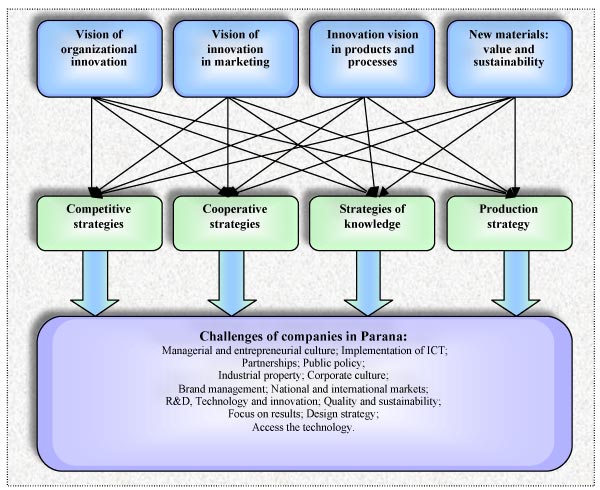
Source: Research figures.
Figure 1− PSRIP innovative visions and strategies for consolidation
The challenges posed by the PSRIP come against the strategies found in the theoretical framework (competitive, cooperation, and knowledge production). They scored four strategies are ways to achieve the visions of organizational innovation, marketing, product and process and new materials.
3. Method
The survey ranks the inductive method, applied nature, exploratory way to approach the problem of quali-quantitative. Quantitative understand for the implementation of the strategies used for the governance of the cluster. Qualitative using structured interviews with staff to promote and external systematic observation of reality of the local cluster. The population of this research was restricted to business agents of the governance of clusters and chair of associations or unions of making the State of Paraná, with the larger organization more than four years old.
The technical procedure was performed with questionnaires with closed questions and multiple choices. So, this was drawn up, containing 7 personal questions, 25 questions on organizational innovation, innovation over 16 marketing, 17 questions on innovation in products and processes and 11 issues in the development of new materials for the clothing sector, totaling 76 points.
Systematic observations in clusters of clothing were intended to establish the existence of training center and design within the clusters, partnerships with national and international institutions, conducting research projects and technology implemented in enterprises. Finally, it was used the structured interviews with professionals, who acted on formation and implementation of action plans of clusters throughout the state of Paraná.
4. Analysis of the level of occurrence of the actions identified in action plans for textile industry clusters
This section provides the analysis of questionnaires filled out by agents of governance on the frequency of delivery of the actions highlighted by the innovative and PSRIP found in development plans of the clusters. So actions are categorized according to the vision of organizational innovation, marketing, products and processes and new materials. Results are presented separately according to the strategy of innovation to be searched. Some results have direct quotes from agents of governance of clusters and presidents of associations and unions. Because they present and make the realities found in the data and the difficulty of forming partnerships with companies for product development.
4.1 Organizational Innovations: business networks
This category of innovation works with the help of the innovative actions of the clusters could contribute to the development of the organization of SMEs in the textile industry. These formations management and corporate culture that the organization offers for the business network, the level of partnerships with government, unions and suppliers, the implementations of information technology and communication companies in the cluster and finally the level of public policy made after the organization of the cluster.

Source: Research figures.
Figure 2− Organizational Innovations: business networks
Entrepreneurs of the clusters surveyed are aware of the importance of implementation of collaborative strategies for moving the market. Among the innovations proposed in this research, the organizational innovation that has achieved higher rates. So adding the enough and plausible alternative has almost 60% of cases.
Training management and cultural emphasis on consulting provided by the Brazilian Service of Support Company (BSSC), being praised by the agents of governance respondents. It is observed by a certain dependence of this service, especially for strategic planning of the actions of the clusters. One of the agents of governance said that "at least 900 hours per year are needed for consulting firms in the cluster. Training partners with the largest representation of major importance of the sub PSRIP innovative actions, including stand out partnerships with trade unions and entrepreneurs.
In PSRIP one of the most important is the need to implement Information and Communication Technology (ICT), particularly in SMEs, according to roadmapping methodology performed. This showed the lowest positive rates of existence with the option no occurrence of 28.07% and high occurrence of only 14.04%, which is defined by virtue of the partnership acquisition and training of software modeling and fitting used in the textile industry, but only focused on technical and physical systems, such as databases, equipment, installation and design for physical goods and services.
The data representing the low and no options also shows the difficulty of communication in the cluster companies and as a consequence, the generation and dissemination of ideas and process optimization from the computer innovation. Among the 5 clusters surveyed only 2 have the communication and dissemination through the organization's specific site, again only 2 clusters has a central register of suppliers and representatives access to the computerized business.
4.2 Innovations in marketing: a strong brand image
The competition from Asian products in the market shows the impossibility of choosing strategies based on low prices. So it is necessary to innovate in products, processes and market for the cluster is known in the market with a strong brand.
This view has a small amount of shares of the development plans of making clusters, as shown in Figure 3. Especially with regards to the actions for industrial and business cultures of marketing is noticeable. However, the action found in all clusters was the creation of a logo, but this is only used for bureaucratic reasons.

Source: Research figures
Figure 3 − Innovations in marketing: a strong brand image
This innovation strategy has lower rates positive organizational innovation. The sum of the shares of large and plausible occurrence scored only 39.93% and an index representing no action at 29.04%. What is striking about this reality is that the variable with the highest value of any event was to brand management, especially regarding the brand of the cluster. Contrasting this situation it found high rates of cultures of trademark registration and disclosure and search for new markets. Factor that demonstrates the interest of entrepreneurs in activities to search for innovations do not undermine the culture of not developing products together in clusters.
4.3 Innovation of products and processes: design and technology
This innovation shows the actions in all the clusters related to product development and process itself. Recent studies of innovation show that mass production will tend to a tailor and high added value. Thus, there is a need in the textile industry to innovate products and production processes, focused on design and high technology. Especially with actions focused on quality and sustainability of products, focus on the results of previous collections, as presented in Figure 4.

Source: Research figures.
Figure 4− Innovation in products and processes: design and technology
The innovation of products and processes in the clusters in the textile industry has its strategies and actions only for the acquisition of process technology. When the variable is development of new products this is restricted to study of new international trends. The rate of no action displays the value of 33.16% against 19.25% in enough which shows that the culture of the business is still not rushing to develop products together.
What was stated is that the greater the product variation in the cluster, the greater the difficulty of performing actions in this area. This partnership will benefit the cluster as a whole, because the great difficulty of the garment industry is the production of specialty items in four annual collections according to the seasonality of time for each season (spring, summer, winter and autumn).
Two statements noted the reality of innovation strategies of products and processes in the textile industry clusters. "Participating in the cluster is not being a brother, because I will not buy a technology, particularly equipment, pay for it and offer free knowledge to operate it for the other members." "Do not perform activities of product development together, but after it is released and displayed in the windows, they are copied in a matter of days." However, one development project has highlighted is the “Fashion Designing Project" in which students from three courses of the fashion, present collections in a grand parade.
4.4 New materials used in raw materials: value and sustainability
With regard to new materials used as raw material in textile industry clusters of the State of Parana, more than 78.77% of those involved said that they have no or little knowledge on the subject, as illustrated in Figure 5.

Source: Research figures.
Figure 5 − New materials used in raw materials: value and sustainability
Partnerships strategic actions with suppliers are the greatest difficulty that the clusters in the textile industry are the development of new products, with 53.51% of any occurrence and 25.26% low. Even doing shopping together or by the same representative companies do not see the cluster as a client because of very shy about the volume of purchases in the market. But the cluster of loops of knitting Imbituva has as its main supplier the spinning, so this partnership is to create environmentally friendly products.
The spinning produces yarn with natural dyes and the production makes its production without degradation of the environment, especially without the drawing process. With this company has a strategy of marketing a product of innovative clothing and eco-friendly knit blouse with rapid degradation in the environment. The data obtained in the survey show the reality of poor development of differentiated products within the clusters in the textile industry of the State of Paraná and as a result of development partnership with suppliers of materials and access to these new technologies.
A comparison come organizational innovations, marketing, product and process and new material is presented in Figure 6.

Source: Research figures.
Figure 6: Comparison between the innovations of PSRIP
The innovative action that has the highest rate in the cluster of practices is the management innovation, to support this as one of the interviewees made the following statement. "The cluster concept has come to organize the work already being done by external agents, which often became repetitive by the lack of communication and organization."
So this innovation was a job that was formerly in institutions that promote SMEs and to government, but was not organized. Innovation in marketing is presented together strongly in some regions, but this is divided between large and no options. This is characterized by the nature of the product and the type of inventory, cluster working with wholesale shopping tend to have marketing together. In contrast, companies with representatives investment in marketing the brand.
Innovation and product development process even with the effective participation of academies comes down to buying machines for optimization of new processes and training tools. The development is rarely performed together, the competitiveness between them only allows for cooperation in management innovations. But the critical factor is the innovation of new materials, in partnership with suppliers. This is not consolidated shares in any of the clusters surveyed, due to lack of product development together and to realize the importance of the products to be produced in the arrangement.
It can be considered statistically that there is enough evidence to reject the claim that five samples of musical event denoted by the Likert scale derived from an F too large thus reject the assertion of equality between means using ANOVA. This test conducted on all blocks of innovation questionnaire that is represented by the difference between the means. The value of F: 8.44 with the confidence level of 95% and a critical value of 1. 96.
5. Discussion
It shows the difficulty of evolving from consolidation and training partners for product development and new materials together in the cluster surveyed. It is believed that the cluster that can overcome this phase will have only the challenge of maintaining continued innovation, and must begin business life itself on the market. However, there is no way to complete this research without assessing the level of product development and marketing together in the cluster. So it becomes necessary training of support agencies for advice of entrepreneurs and effective partnerships with research institutions.
Though, these are restricted to run training courses for operators of sewing and cutting machines. SME to evolve into new markets requires strong innovation strategies. But the biggest challenge is to quickly transform the culture of fear to develop products together and make public policies to support development and technology SMEs surveyed. As a proposal the government could submit designs for specific credit lines for implementation of actions for innovation cluster participants who had their reputable companies such as micro, small and medium size business.
However, even with the difficulties of development and consolidation in the textile industry cluster, it was observed the creation of strong regional business leaders for the State of Paraná. The knowledge gained by these people is a strong strategy for regional development, a factor that only a strategy of cooperation among businesses, universities, supporting agencies and governments can provide. How is management the clusters of textile industry of Paraná stopping phase of partnership with external agents to evolve or develop products and processes together?
References
ALTERBURG, T & MEYER - STAMER, J. (1999). “How to promote clusters: policy experiences from Latin America”. World Development, Vol. 27, n.9, p.1693-1713.
CARPINETTI, L. C., GALDÁMEZ, E. V., GEROLAMO, M. C. (2008). “Measurement system for managing performance of industrial clusters”. International Journal of Productivity and Performance Management, Vol. 57, n.5, p.405 - 419.
JOINER, T. A. , SPENCE, S.Y. & SALMON, S. (2009). “The effectiveness of flexible manufacturing strategies: the mediating role of performance measurement systems”. International Journal of Productivity and Performance Management, Vol. 58, n.2, p.119-135.
SCHUMPETER, J.(1943). Theorie der wirtschaftlichen Entwicklung. Leipzig: Duncker & Humblot. Cambridge, MA: Harvard University Press.
NONAKA, I., TOYAMA, R. & KONNO, N.(2002). SECI, Ba and leadership: a unified model of dynamic knowledge creation. In: Managing knowledge an essential reader. London, Sage Publications.
PHAAL, R., FARRUKHA, C. & PROBERT, D. (2005). “Developing a technology roadmapping system”. Portland International Conference on Management of Enginneering and Technology. Portland, USA: PICMET’05, 99 -11.
PORTER, M. (1998). Clusters and new economics of competition. Harvard Business Review, New York, Vol.76, p. 77 - 92.
SENAI. (2007). Departamento regional do Paraná. Rotas Estratégicas para o futuro paranaense: roadmapping de produtos de consumo - 2015. Curitiba: SENAI/PR.
SCHUMPETER, J. A. (1934). “The analysis of economic changes”. Review of Economic Statistics, May, p. 2-10.
SOUZA, S. D. & ARICA, J. (2006). “Mudança tecnológica e estratificação competitiva em um arranjo produtivo local do setor ceramista”. Revista Producão. São Paulo. Vol.16, n.3, p.88 – 99.
WEBB, C. (2008).”Measuring social capital and knowledge networks”. Journal of knowledge Management. Vol. 12, n.5, p.65-78.