Introduction
We have been seeing advances of Latin American banks into international markets and some like Itau Unibanco are gaining prominence as transnational corporations. The objective of this paper is to approach an explanation for the internationalization of Latin American banks based on the literature, but also including a modified form of the follow-the-client hypothesis in which unrequited transfers, or remittances from immigrants play a relevant role. The paper draws mostly upon the experience of Brazilian banks but also considers also Chile and Colombia (these three countries are the only which record financial OFDI according to UNCTAD), and Mexico.
The novelty here is the analysis of the role of remittances which may be a unique characteristic of Latin American banks when they internationalize, thus questioning whether extant theory devoted to bank internationalization will need to be refined to account for specific regional phenomena.
Two apparently unlinked accounts of the Balance of Payments, namely current transfers and foreign direct investment, may bear an indirect relationship in the context of some developing countries. Apparently, their only relevant common feature seems to be the cross border nature. However, a high volume of cross border transactions that are at least partially captured by banks located on the destiny of the transfers may contribute to the accrual of knowledge of international markets for these banks and, according to behavioral theories, knowledge of international markets may lead to FDI in sequential stages.
The relevance of the paper stems in the examination of a relatively recent phenomenon which is the formation of multinational banks (MNBs) from Latin America, in light of existing theory while adding a new element that I have found to be a missing piece in the literature. The bulk of the research that deals with or touches unilateral transfers is outside the international business field being mostly related to international factor mobility and its economic consequences; and social impacts.
In the IB field, there are important considerations by IB scholars in the context of human networks and diaspora (Oettl and Agrawal, 2008; Madhavan and Iriyama, 2009; Filatotchev et al, 2009; Gillespie et al, 1999). For instance, Oettl and Agrawal (2008) examine knowledge externalities (“unintended” knowledge flows from the movement of inventors and do not accrue to the hiring firm but result from the movement, where a firm that lost the inventor actually gains from the diaspora). Buckley et al (2007) also see ownership advantages arising from diaspora in the case of Chinese firms’ outward FDI. They found that “the facilitating role of the Chinese diaspora persists throughout the period under study, as expected, and suggests that relational assets indeed constitute an ownership advantage for Chinese firms when they invest in countries with a significant Chinese population” (Buckley et al, 2007). John Dunning in his thoughts on receiving the Journal of International Business Studies 2008 Decade Award included diaspora investments among the new forms of FDI that he foresaw to increase (Dunning, 2009) and this modality is actually growing in importance in IB studies.
However, to my knowledge, there is little or no consideration of the externalities associated with the creation of the financial flows in the form of current transfers between origin and destiny countries. Specifically, I believe these transactions play a role in boosting bank FDI in some specific contexts and that this approach may also contribute to a wider understanding the effects of diaspora phenomena. This can be one of the drivers of the formation of Latin Multinational Banks (MNB), as these transactions have been playing a relevant role in the international expansion of banks from the region. The next section reviews relevant literature on MNBs, followed by a description of the current transfers/remittances phenomena. I then present the experiences of Latin banks with a discussion section where a typology is proposed.
Internationalization of banks
There is already a significant literature on the internationalization of banks. While Focarelli and Pozzolo (2000) note that the literature on banking internationalization concentrates on the eclectic theory – they provide a discussion of the literature on firm-specific (size, efficiency) and location-specific (economic integration, regulation, local market opportunities) factors – Qian and Delios (2008) argue that internalization together with the eclectic paradigm are the most widely applied.
A key hypothesis on MNBs is the client following behavior hypothesis from late seventies, which suggest that imperfection in factor markets assign MNBs with unique, non-tradable knowledge about their clients; also, the continuous relationship with multinational corporations significantly diminishes the costs of information for banks, leading them to internationalize in line with their clients’ internationalization directions (Sabi, 1988; Williams, 1997). A relevant portion of bank FDI would, as a consequence, be dependent on non-bank FDI and the latter would be a precursor of the former (Qian and Delios, 2008).
Under a different, internalization-based perspective, Qian and Delios (2008) also see this market failure leading to high transaction costs in the information/knowledge intermediate products segment when the transaction takes place in a foreign market. However, they see an inconsistency since they propose banks’ internationalization is no longer related to non-bank FDI as there is evidence that MNBs have been lending to non-home country borrowers. They add more recently literature regarding possible dynamic aspects in which the bank “could initially be following its clients to subsequently gain access to host country non-bank clients”, by further developing capabilities or assets. The initial client-led movement would then be a beachhead to further seeking of new market opportunities.
The “follow-the-client” argument (hereafter FTC) also known as defensive expansion because the bank tries to retain clients that are expanding overseas, refers mainly to banks pursuing medium-to-large corporate clients to provide them with banking services in a new jurisdiction where the client has established through foreign direct investment. Extending the line of argumentation beyond that product line seems more difficult, except for the location factor, like when a bank goes to foreign markets to benefit from economies of scale or scope in its entire operation.
Qian and Delios (2008) argue on the basis of intangible assets including skills and abilities in several areas, and they say it would be profitable to exploit those intangible assets in international markets when the gains in economies of scale or scope are lower than the costs of the entry. The eventual possession of intangible assets, however, may be conducive to aggressive rather than defensive entry. Henceforth I will call the aggressive entry based on intangible assets (believed to exist or effective) the Search for New Market (SNM) hypothesis.
There are possible other location reasons, like Luo and Tung (2007) who argue that increasing company size and reputation is a motive for creation of MNEs from emerging countries. They point out specifically Brazilian banks as pursuers of this objective, including Bradesco, Banco do Brasil, and Unibanco, through investments in Europe and Latin America.
Regulation is an important location factor since, as Sabi (1988, p. 437) points out, “the necessary condition of multinational banking activities is securing the permission of host countries”. In the context of remittances, however, the very nature of business is transnational and thus the institutional rules of two jurisdictions matter in the transaction. Multinational banking if appears in connection with transaction would have to deal with two regulations, namely the origin and destiny rules. This is more similar to trade financing lines, which are also cross-jurisdictional in nature. The findings by Sabi (1988) that U.S. MNBs are less interested in trade loans in LDCs than in domestic loans, possibly reflects this two-jurisdiction difficulty and could help to explain why banks from the developed world are less prone to succeed in the transfers business.
Bank internationalization has also been viewed in light of behavioral theories of internationalization of businesses in general. In particular, the establishment chain for internationalization of firms proposed by Johanson and Vahlne (1977), that was set up according to the psychic distance (factors that make it difficult to understand foreign environments), in a dynamic but non deterministic process that evolves over time with learning and incremental commitment building, under a bounded rationality assumption.
Miller and Parkhe (2002) asked whether there is a liability of foreignness in global banking. Their answer is yes, on the basis of differential levels of efficiency of foreign-owned banks against host country banks. They used 13 host countries and confirmed the finding of earlier studies that were mostly confined to U.S. banks.
As an evolution of the Uppsala model, Johanson and Vahlne (2009) proposed an update of their theory. As Eden (2009) puts it, “outsidership relative to the relevant network, rather than psychic distance, is the root cause of uncertainty and precipitates the internationalization process” (Eden, 2009, p. 1409). In the original theory, liability of foreignness was a key concept, while in the new version a relevant concept become the liability of outsidership, in relation to a relevant network.
Buch (2003) investigated the relative importance of information costs (proxied through distance, language and legal system) and regulations, on the destiny of international expansion of banks. She found mixed results: while some banks like the Spanish ones expand into informationally close markets, others prefer to tap locations with relatively low regulatory entry barriers.
Focarelli and Pozzolo (2000) point out that the literature on international banking has considered three kinds of operations, namely loan provision and asset and liability management with foreign counterparts; foreign branching; and the acquisition of shareholdings in foreign banks (subsidiaries). The latter two are of more interest in this paper. However, they can be viewed in some way sequentially, according to behavioral theories of internationalization. The sample of banks in this paper shows that foreign branching prevails as the key operation in multinational banking from Latin America. Basically, Brazilian banks are almost the only few that are heavily investing abroad not only through branching but also through the creation of subsidiaries.
More formally, I present below the relevant hypotheses of this paper. Since a proposed contribution of this paper lies in the analysis of the role of remittances, for testing those hypotheses, I will first describe that phenomenon and then I discuss the experiences of Latin American banks.
Hypothesis 1: bank internationalization from Latin America follows motives explained by traditional theories with an additional motive. Since banks from (relatively) less developed countries have an ownership advantage in capturing ethnically-originated financial flows of considerable amount and this advantage creates knowledge flows that may lead to foreign direct investment thus causing their internationalization into developed markets, remittances are a driver of internationalization of Latin banks.
Current transfers
Unrequited transfers or unilateral current transfers, or just current transfers are a component of the current account in the Balance of Payments associated with remittances from migrants. The main origin of such transfers is a high-income countries, which account for 85.5% of emigrants from Latin America and the Caribbean, according to World Bank Factbook data for 2010. There is a semantic issue to be tackled here, namely the confusion between origin and destiny. The Chart below offers a view of the definition that will be used hereafter in this paper.
Chart – Financial origin and destiny of current transfers
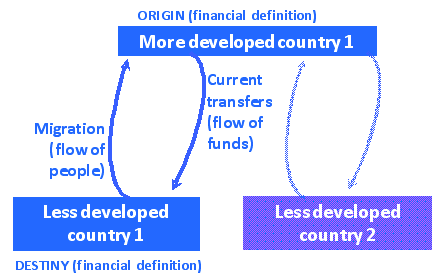
Since my analysis concerns current transfers and not population transfers, the definition of origin and destiny to be used in this paper is financial rather than demographic. Hereafter in this paper, I will term origin the more developed nation where the migrants reside and from which they send current transfers into a (relatively) less developed nation.
There are also intra-region flows are also important, for example, from the largest countries like Brazil to the smallest ones like Bolivia. The same scheme depicted in the above Chart applies, noting that Brazil would stand for the more developed country and Bolivia the less developed. There are more specific cases of so-called South-South remittance flows, like the Costa Rica-Nicaragua corridor case, which are not deemed to be relevant for the purposes of this paper (for a detailed analysis of this case, see Monge-Gonzalez, Céspedes-Torres and Vargas-Aguilar 2009; and Fagen and Bump, 2005).
At first, historically there has been and is still under way a massive transfer of immigrants from less developed to developed economies. Estimates for 2010 from The World Bank (Factbook 2011) report that the stock of emigrants in 2010 was currently 30.2 million of people from Latin America and the Caribbean, or 5.2% of the population of the region live outside their home countries. Their destinations are: high-income OECD countries (84.8 percent), high-income non-OECD countries (0.7 percent), intra-regional (12.9 percent), other developing countries (0.1 percent), unidentified (1.6 percent).
For at least the last three decades, unilateral transfers from these migrants to their home country have been an important source of external revenues to Latin America and their macroeconomic importance is growing over the years, as shown in the table below.
Graph – Balances of unilateral transfers and current account, US$ billions of 2009
|
1980 |
1990 |
2000 |
2009 |
Current transfers balance |
4.5 |
15.5 |
26.4 |
57.6 |
Current account balance |
-77.6 |
-6.1 |
-59.8 |
-14.5 |
Source: United Nations/Economic Commission for Latin America and the Caribbean. Original data converted to 2009 prices in US Dollars using CPI all-items from the US Bureau of Labor Statistics.
According to Terry (2005), “remitters to Latin America and the Caribbean usually send money in small amounts: $200 to $300 each month is most typical. In other parts of the world, monthly amounts can be much less, often ranging from as little as $50 to $100”. There still exists a lot of hand-carried money and a numerous transactions are carried outside the financial system, with international money-transfer companies or local neighborhood operators play a significant role. For this reason, balance of payments accounting is not precise and an important part of the flows may be registered in the “errors and omissions” accounts (Terry, 2005).
Notwithstanding, it is noteworthy the transformation that is depicted by Suro (2005, p. 21): “by the standards of international finance, the size of the average remittance transfer by migrants is miniscule—$200 to $300—but the cumulative sums have now captured the attention of governments, international organizations, and financial institutions across the Western Hemisphere. Not long ago, remittances were part of a cottage industry in which cash was often hand-carried across borders. Now remittances are big business and are widely recognized as a source of vital income to many developing countries and an important form of economic activity among nations”. With this huge mass of people resident in developed economies and the back home there appeared a significant demand for a specific financial service, namely money transfers into their country of origin.
There is a short description of the money transfers market in MoneyGram (2010, p. 5) “the market consists of a small number of large competitors and a large number of small, niche competitors. Our competitors include other large money transfer and electronic bill payment providers, banks and niche person-to-person money transfer service providers that serve select regions. As new technologies for money transfer and bill payment services emerge that allow consumers to send and receive money and to pay bills in a variety of ways, we face increasing competition. These emerging technologies include online payment services, card-based services such as ATM cards and stored-value cards, bank-to-bank money transfers and mobile telephone payment services”.
The two key incumbents of the remittances market in the United States are Western Union and MoneyGram. Western Union was founded in 1851 as a telegraph company and started money transfers in 1871. The company claims to have 435,000 Agent locations in 200 countries and territories. MoneyGram operates through “a global network of third-party agents that use our money transfer systems”. They claim most of their clients are not fully served by financial institutions. Euronet Worldwide is also an important player (corporate websites, access in January 2nd, 2011).
Major banks have entered the market for transfers. In the United States, first movers included Wells Fargo’ InterCuenta Express launched in 1997 after Dinero al Instante; Bank of America’s SafeCard; Citibank’s C2it and Money Card (Bair, 2005), however in many cases not successfully (Berney, 2007). Even official efforts were devoted, like in the extension of the Federal Reserve’s Automated Clearing House (ACH) to Mexico in 2004, lowering the costs of electronic fund transfers from the United States to Mexico. However, financial institutions of developed nations may be better prepared to deal with that demand if it were not for a handful of barriers to entry in this market, including: national regulations at both destiny and mainly at the origin jurisdictions, now enhanced by terrorism and money laundering requirements; the idiosyncrasies of the destiny countries and their culture and language; the diversity of destinies of the transfers; and very importantly the lack of documentation, the informality, and prevailing cultural distrust on major banks among immigrant communities. This was a window of opportunity for destiny banks (i.e., banks located in the destiny countries) to handle those transfers, even in partnership with other operators.
In Central America, remittances are helping to boost demand for banking services (ECLAC, 2007), leading to bank internationalization. However, Banistmo of Panama was acquired by HSBC in 2006 with a target at the remittances market, what ECLAC (2007) sees this transaction as another relevant fact on the issue of whether trans-Latinas can survive against the competition of major international groups.
For some countries, the volume of those transactions is so large that it became wise for banks to set up a branch in the origin country targeting mainly the immigrants, although benefiting from economies of scope with diversified banking services. In the latter case the principal target group may not be the immigrants’ pool but rather the business community for trade financing and other activities.
The 2008 crisis reduced unilateral transfers from 64 billions of dollars in 2008 to 58 billion in 2009, but still the transfers kept a significant level in light of the high magnitude of the crisis. Transfers seem to be less sensitive to exchange rate and economic activity gyrations than the other items of the current transactions account. Because of this relative stability, current transfers are attractive both for public policies towards external sector equilibrium and for bank strategies towards securitization of receivables.
The microeconomic nature of the business activity related to transfers is also relevant for the purposes of the understanding of the phenomenon. While banks enjoy economies of scale and scope, the money transfer business is likely to benefit more from economies of scale than of scope. As a consequence, the transfers business is quite concentrated in the hands of a few players. The existence of a large number of small providers of transfers would not challenge this argument unless they were able to price as their very existence may be closely linked to market failures, mainly information asymmetries that create room for niche players that developed some sort of reputation, or as a result of illegal or hidden status. Industry commentators say the price charged by these niche operators can be many times higher. It would be hard to believe that these higher prices come from the demand side in the form of allocative inefficiencies, given the high number of competitors; it is more likely that those prices include productive inefficiencies from the supply side, because small plants are costly in this business.
The possible presence of economies of scale is not a good reason to explain why banks are seeking more prominence in the transfers market, since the leading players like Western Union and MoneyGram already enjoy those economies. It is probably the potentially underexploited economies of scope between transfers and other commercial product lines that may be behind those strategic moves that have been widely observed. Only economies of scope can explain why transfers are offered for free for some type of clients, including but not limited to the wealthiest ones.
Against that background, MoneyGram, for example, which is the second largest provider and probably enjoys economies of scale from its size but not of scope – as it explicitly says most of their clients are not fully served by financial institutions. However, the potential economies of scope in this market may not be automatically realized once a bank enters the market. Information asymmetries, externalities and other failures may prevent banks from succeeding in that business in an efficient manner, thus explaining regulatory initiatives like that from the Federal Reserve and from the U.S. government towards a higher presence of banks in the transfers market.